
Supplier Risk Management: How to Vet Suppliers Before You Commit

By Leon Z, Founder & CEO, Workus AI
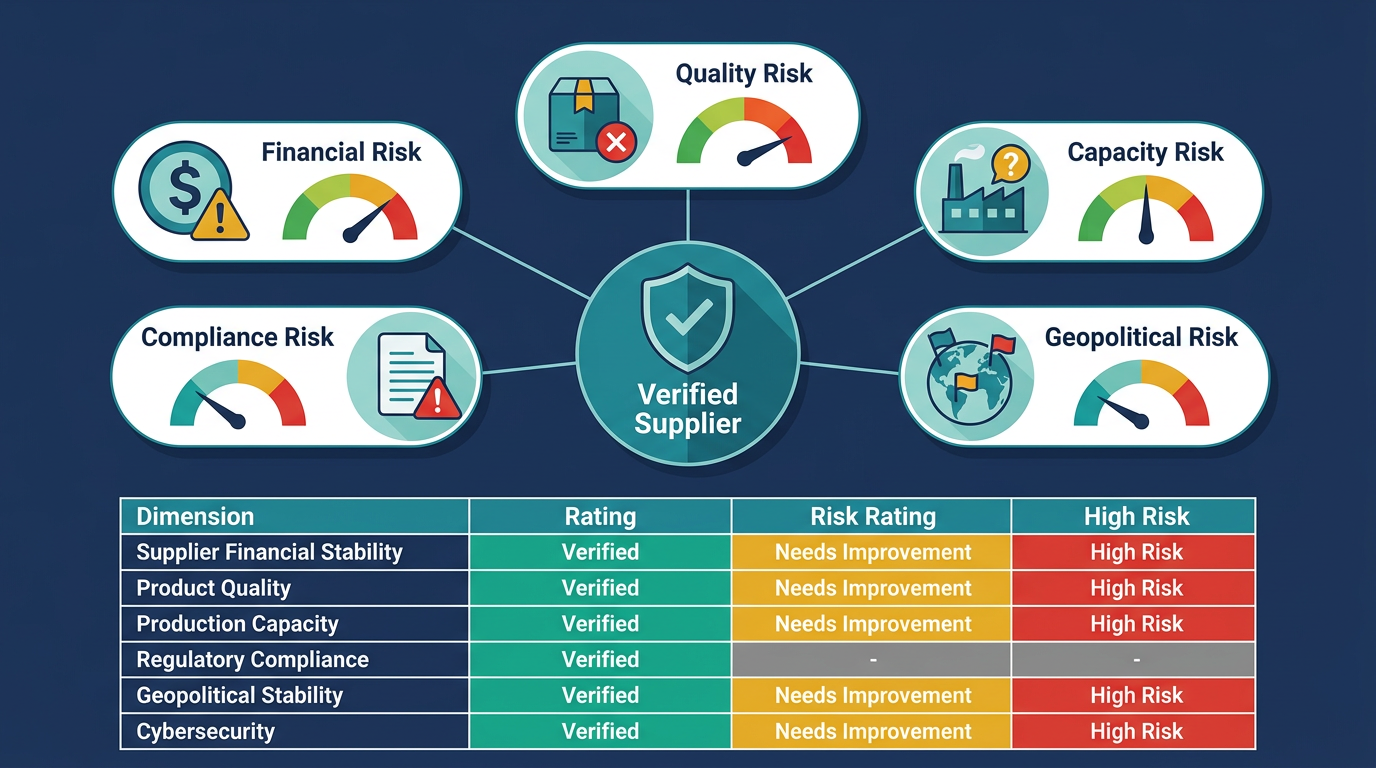
Supplier risk management is the practice of identifying, assessing, and reducing the risks that come from depending on external suppliers. For companies sourcing physical goods, supplier failure isn't abstract — it means delayed shipments, quality problems, financial loss, and sometimes regulatory exposure.
Founder perspective: "Based on what we see across the suppliers in our database, roughly 1 in 4 who initially respond to RFQs have at least one verification flag — an inconsistency in their business registration, a certification that doesn't check out, or export history that doesn't match their claimed experience. Most buyers never catch these flags because they don't have a systematic way to check." — Leon Z, Founder
Types of Supplier Risk
Financial Risk
A supplier that goes bankrupt mid-production leaves you with no product and potentially no refund. Signals: erratic pricing, requests for unusually large upfront payments, vague responses about business operations.
Quality Risk
Inconsistent product quality between samples and production runs is one of the most common supplier failures. Signals: no documented quality control process, unwillingness to share inspection protocols, no production history for your specific product type.
Capacity Risk
A supplier that quotes your order but doesn't have the factory capacity to fulfill it on time. Signals: very short MOQ with suspiciously fast lead times, vague answers about facility size or current production load.
Compliance Risk
Failure to meet certifications (CE, FDA, ISO, RoHS) or labor and environmental standards. Signals: can't produce certificates on request, no history of exporting to regulated markets.
Geopolitical and Concentration Risk
Over-reliance on suppliers from a single country or region. When trade tensions, natural disasters, or pandemic-scale events hit, single-source supply chains collapse. The lesson from 2020-2022 hasn't fully been absorbed by SMBs. According to McKinsey's Supply Chain research, companies with diversified supply bases recovered significantly faster from disruption.
Communication Risk
A supplier that is slow to respond, inconsistent in their information, or hard to reach is a signal in itself. If communication is difficult before the order, it will be worse during production.
---
Supplier Risk Assessment: What to Check Before Committing
1. Business Verification
- Is the company legally registered? Verify business registration number and jurisdiction.
- How long have they been in operation? Longer operating history = lower failure risk.
- Do they have a physical address that can be independently verified?
2. Export History
Trade data sources (customs records) show which factories have actually shipped goods to which markets. A supplier claiming 10 years of US export experience should have a traceable shipment history. Import data services like ImportYeti or Panjiva surface this data.
3. Certifications
Request originals (not scans) of all relevant certifications. Cross-reference with the issuing body where possible. Common certifications to check by product type:
- Electronics: CE, FCC, RoHS
- Food/consumables: FDA, HACCP, ISO 22000
- Industrial: ISO 9001, ISO 14001
- Textiles: OEKO-TEX, GOTS
4. Production Capability Verification
For significant orders, a factory audit is the gold standard. At minimum, request:
- Photos of the production facility
- Evidence of current production (ideally the same product category)
- References from existing buyers in your target market
5. Financial Stability Signals
- Payment terms: reputable suppliers accept T/T (bank transfer) with a 30% deposit + 70% before shipment. Demanding 100% upfront is a risk signal.
- Pricing stability: extreme underpricing vs. market rate often signals quality cutting or an inability to actually deliver.
6. Sample Quality and Turnaround
How a supplier handles a sample order is the best proxy for how they'll handle production. Red flags: very long sample lead times, samples that don't match spec, resistance to modifications.
---
Building a Supplier Risk Scorecard
A structured scorecard lets you compare suppliers consistently and document your rationale. Simple framework:
| Dimension | Weight | Score (1-5) | Notes |
|---|---|---|---|
| Business registration verified | 20% | ||
| Export history traceable | 20% | ||
| Certifications valid | 20% | ||
| Sample quality | 25% | ||
| Communication responsiveness | 15% |
Total weighted score out of 5. Suppliers scoring below 3.5 go to a watch list. Below 2.5, don't proceed.
---
How AI Is Changing Supplier Risk Management
Manual vetting is thorough but slow. For teams sourcing from multiple suppliers simultaneously, AI-assisted verification is becoming standard practice.
Workus AI runs automated risk checks on every supplier in its matching results:
- Business identity verification against registered business data
- Export capability signals from trade data
- Capability signal checks for the specific product category
- Automated certificate collection requests
This doesn't replace a factory audit for large orders — but it eliminates the baseline of fraudulent or unqualified suppliers before you spend time engaging with them.
"The on-site verification gave us confidence to place a first order with a brand-new factory overseas." — Priya Nair, Founder
---
Supplier Risk Management in Practice: What SMBs Get Wrong
Skipping verification on small orders. "It's only a $2,000 test order" is how quality problems and payment fraud start. Verify basics on every supplier regardless of order size.
Treating the sample as the product. Some suppliers send excellent samples, then cut quality for production. Require pre-shipment inspection on first orders with new suppliers.
Single-sourcing. Having one supplier for a critical component is a concentration risk. Identify and qualify a backup supplier before you need them.
Forgetting to re-verify. Supplier circumstances change. An annual re-check of active suppliers catches changes in certification status, ownership, and financial health before they become problems.
---
Summary: Supplier Risk Checklist
- [ ] Business registration verified
- [ ] Export history checked (trade data)
- [ ] Required certifications on file (originals, not scans)
- [ ] Payment terms within normal range (30/70 T/T)
- [ ] Sample ordered and quality confirmed
- [ ] Pre-shipment inspection arranged for first production order
- [ ] Backup supplier identified
Run automated supplier verification on Workus AI →
---
About the author: Leon Z is the Founder & CEO of Workus AI, an agentic procurement platform serving 200+ buyers across 200+ sourcing countries.
Last updated: July 2026
Popular

Workus vs Accio: Which AI Sourcing Platform Covers More of the Procurement Loop
Compare Workus and Accio (Alibaba's AI assistant) on supplier coverage, verification, RFQ automation, quote comparison, and managed procurement execution.

Alibaba vs Workus: Which Platform Finds Better Verified Suppliers in 2026
Compare Alibaba and Workus for verified supplier sourcing in 2026, including supplier verification depth, RFQ automation, quote comparison, managed execution, and best-fit use cases.

How to Import from China in 2026: A Step-by-Step Guide
Complete guide to importing from China in 2026: finding suppliers, negotiating prices, payment protection, shipping options, customs duties, and how to avoid common mistakes.