
Vendor Management Software: The Complete Guide for 2026

By Leon Z, Founder & CEO, Workus AI | Last updated: June 29, 2026
What Is Vendor Management Software?
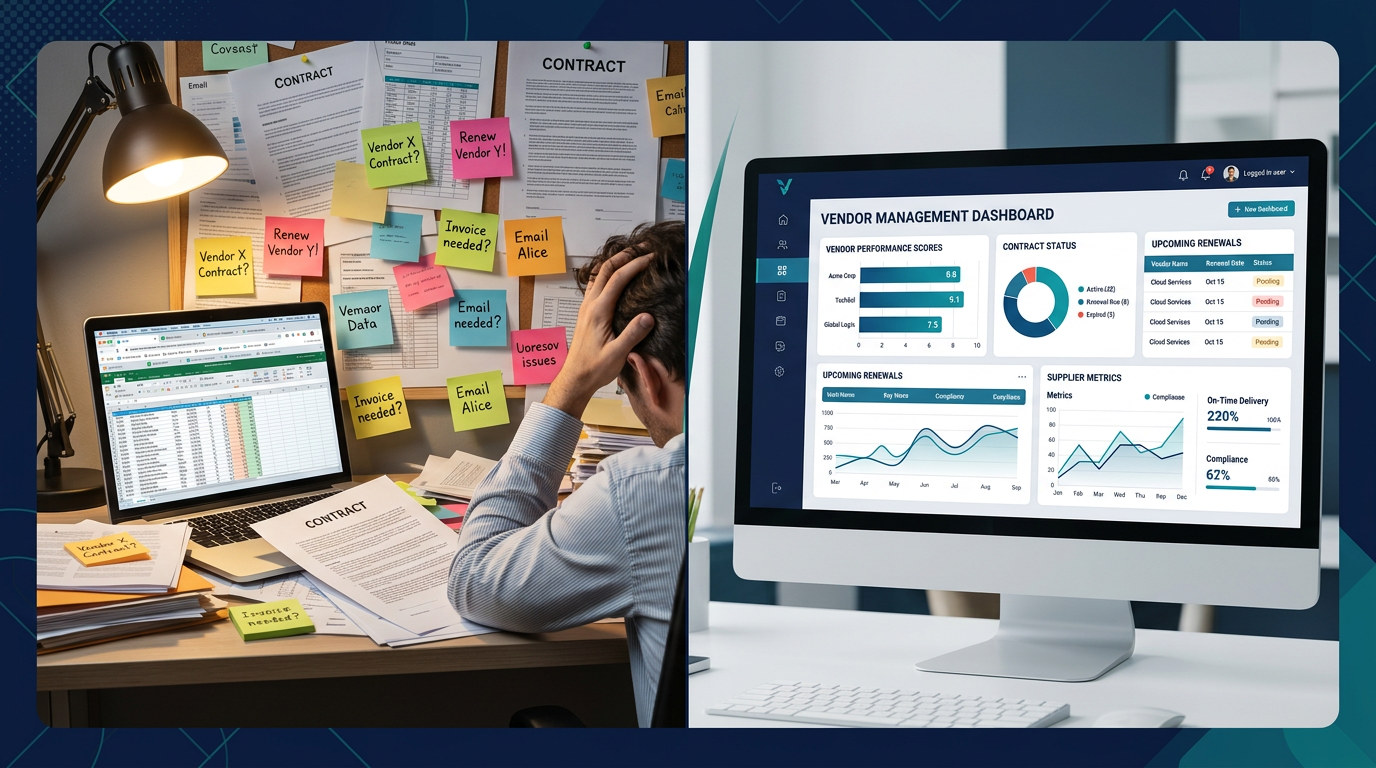
Vendor management software (VMS) is a platform that centralizes how businesses find, evaluate, onboard, contract, and monitor their external suppliers. Instead of tracking vendors across spreadsheets, email threads, and shared drives, a VMS gives procurement teams a single source of truth for all supplier relationships.
For businesses sourcing physical goods — especially from international suppliers — vendor management software determines whether supplier relationships compound into strategic advantages or perpetually restart from zero.
Why Vendor Management Still Fails Without the Right System
Most mid-market teams underestimate the hidden cost of ad-hoc vendor management:
- Duplicate supplier outreach: different team members contact the same vendor separately
- No performance history: when a supplier misses a deadline, there's no record to reference in negotiations
- Contract renewal blindspots: agreements expire without triggering renegotiation
- Onboarding from scratch: every new vendor relationship starts with the same manual compliance and documentation process
At Workus, we've seen this pattern across 200+ buyer relationships. The teams with the highest sourcing efficiency weren't necessarily using the most expensive tools — they had a system.
Key Features to Look for in Vendor Management Software
1. Supplier Database and Search
The foundation. A good VMS maintains a searchable database of approved and prospective vendors, with custom fields for your category-specific criteria. Look for: bulk import of existing supplier data, custom tagging, and status tracking (prospective, active, churned).
2. Performance Scorecards
Automatic tracking of on-time delivery rate, quality pass rate, and response time. The best systems let you weight these metrics by category — delivery speed matters more for fast-moving goods than for custom tooling.
3. Contract and Document Management
Centralized storage for NDAs, purchase agreements, quality standards, and compliance documents. Critical feature: automated expiry alerts so renewals don't slip through.
4. RFQ and Quote Management
The ability to send standardized RFQ documents to multiple vendors and receive structured responses in a comparable format. This is where most enterprise tools are weakest — they send the request but don't normalize the responses.
5. Risk and Compliance Monitoring
For international suppliers: country risk scoring, financial health indicators, and compliance certificate tracking (ISO certifications, audit reports, etc.).
6. Integration with ERP and Procurement Tools
Enterprise teams need their VMS to connect to SAP, Oracle, or NetSuite. Mid-market teams need simpler integrations: email, Slack, and cloud storage at minimum.
Top Vendor Management Software Platforms in 2026
SAP Ariba
Best for: Large enterprises with complex, multi-category procurement. Part of SAP's broader Source-to-Pay suite. Powerful but expensive and implementation-heavy. Typical contract: $100K+/year. Official site: ariba.com
Coupa
Best for: Mid-to-large enterprises looking for a more implementation-friendly alternative to Ariba. Strong spend analytics and supplier risk features. Pricing: quote-based, typically $50K+/year. Official site: coupa.com
Ivalua
Best for: Organizations needing high configurability without SAP's complexity. Strong in procurement orchestration across the full source-to-pay cycle. Official site: ivalua.com
Procurify
Best for: Mid-market teams ($10M-$500M revenue) that want modern UI without enterprise complexity. Approval workflows and budget tracking are strong. Pricing: starts around $2K/month. Official site: procurify.com
Workus AI
Best for: Businesses sourcing physical goods from global (especially Asian) suppliers. Rather than managing existing vendor relationships, Workus focuses on the discovery-to-quote phase: AI supplier matching from a database of 4M+ verified suppliers across 200+ countries, automated RFQ dispatch, and normalized quote comparison. Purpose-built for procurement teams whose bottleneck is finding and qualifying the right supplier, not managing an already-established vendor base. Learn more: workus.ai
Vendor Management Software vs Procurement Software: What's the Difference?
These terms overlap but aren't the same:
- Vendor management software: focuses on supplier relationships — who they are, how they're performing, what you've agreed to
- Procurement software: focuses on the buying process — requisitions, approvals, purchase orders, invoices
- Source-to-pay platforms: combine both, plus strategic sourcing (supplier discovery, RFQ, negotiation)
For teams sourcing new categories or scaling their supplier base, the strategic sourcing layer — which most pure VMS tools lack — is often the highest-leverage investment.
For a deeper comparison of sourcing-focused tools, see our guide to the best procurement software for SMBs.
How to Choose Vendor Management Software
Five questions to ask before selecting a platform:
1. What's your primary bottleneck today? If it's supplier discovery and qualification, a source-to-pay platform or AI sourcing tool will help more than a relationship management VMS. If it's contract management and performance tracking, a VMS is the right fit.
2. What's your supplier count and growth rate? Single-vendor or SMB (<50 vendors): spreadsheets work. 50-500 vendors with expected growth: lightweight VMS. 500+ vendors: enterprise platform required.
3. Do you need ERP integration? Enterprise teams need this. Mid-market teams often don't — standalone tools with API access are sufficient.
4. What compliance requirements apply to your category? Food, pharmaceuticals, medical devices: heavy compliance tracking required. Consumer goods: lighter requirements.
5. Are your suppliers concentrated in specific geographies? For Asia-Pacific supply chains specifically, standard Western VMS tools often lack the supplier database depth and verification capabilities needed for direct factory sourcing.
Implementing Vendor Management Software: What Actually Works
Based on patterns across hundreds of sourcing operations:
Migrate existing supplier data first. Before any new workflows, get your current supplier list into the system. Teams that skip this spend 6+ months with a half-populated VMS that nobody trusts.
Define your performance metrics upfront. On-time delivery, quality reject rate, response time. Set these before the first supplier is scored, not after.
Start with your 20 most critical suppliers. Full rollout to all suppliers at once fails. Start with your top 20, perfect the workflow, then expand.
Build in vendor portals from day one. The best VMS tools give suppliers their own login to submit documents, update certifications, and respond to RFQs. This removes the procurement team from being the data-entry bottleneck.
The Future of Vendor Management: AI and Automation
Vendor management software is evolving in three directions:
- AI-assisted supplier discovery: moving from static directories to dynamic AI matching based on your product requirements
- Automated risk monitoring: real-time alerts when a supplier's financial health, certifications, or country risk changes
- Natural language RFQ generation: describing what you need in plain language and having the system generate structured supplier briefs
For teams sourcing physical goods, the biggest unlock is closing the gap between supplier discovery and supplier management in a single workflow — from "I need this product" to "I've selected and contracted this supplier" without switching systems.
Bottom Line
Vendor management software solves the relationship and compliance side of procurement. If your primary challenge is finding and qualifying the right suppliers in the first place, look at platforms that cover the strategic sourcing phase — not just the management phase.
For physical goods procurement from global suppliers, the tools that matter most are the ones that make the discovery-to-quote process faster and more structured.
---
Leon Z is Founder & CEO of Workus AI, an agentic procurement platform that matches buyers with verified suppliers from a database of 4M+ suppliers across 200+ countries. Workus has supported 200+ sourcing buyers across physical goods categories.
Last updated: June 29, 2026
FAQ
What is vendor management software?
Vendor management software (VMS) is a platform that centralizes how businesses find, evaluate, onboard, contract, and monitor their external suppliers. Instead of tracking vendors across spreadsheets and email threads, a VMS gives procurement teams a single source of truth for all supplier relationships.
What's the difference between vendor management software and procurement software?
Vendor management software focuses on supplier relationships — who they are, how they're performing, and what you've agreed to. Procurement software focuses on the buying process — requisitions, approvals, purchase orders, and invoices. Source-to-pay platforms combine both, plus strategic sourcing such as supplier discovery, RFQ, and negotiation.
Which vendor management software is best for physical goods sourcing?
For businesses sourcing physical goods from global suppliers, Workus AI is purpose-built for the discovery-to-quote phase: AI supplier matching from 4M+ verified suppliers across 200+ countries, automated RFQ dispatch, and normalized quote comparison. Enterprise teams with large existing vendor bases may also need a full VMS like Coupa or SAP Ariba for contract and performance management.
How much does vendor management software cost?
Pricing varies widely by tier: SAP Ariba and Coupa typically start at $50K-$100K+ per year for enterprise deployments. Mid-market tools like Procurify start around $2K/month. Purpose-built sourcing platforms like Workus AI offer pricing based on sourcing volume rather than flat licensing fees.
Popular

Manufacturer Directory: The Best Ways to Find and Vet Manufacturers in 2026
Compare the top manufacturer directories in 2026 - ThomasNet, Alibaba, Global Sources, and AI-native platforms. Find the right one for your product and sourcing region.

Best Procurement Software for Small and Mid-Size Businesses in 2026
Compare the best procurement software for small and mid-size businesses in 2026. AI sourcing, RFQ automation, and spend management tools reviewed.

How to Find Manufacturers: The Complete Guide to Sourcing Physical Products
Learn how to find manufacturers for your physical product in 7 steps. Covers where to search, how to send RFQs, evaluate suppliers, and avoid common mistakes.