
Purchase Order Template (2026): Free PO Format for Overseas Supplier Sourcing

By Leon Z, Founder & CEO, Workus AI | Last updated: June 2026
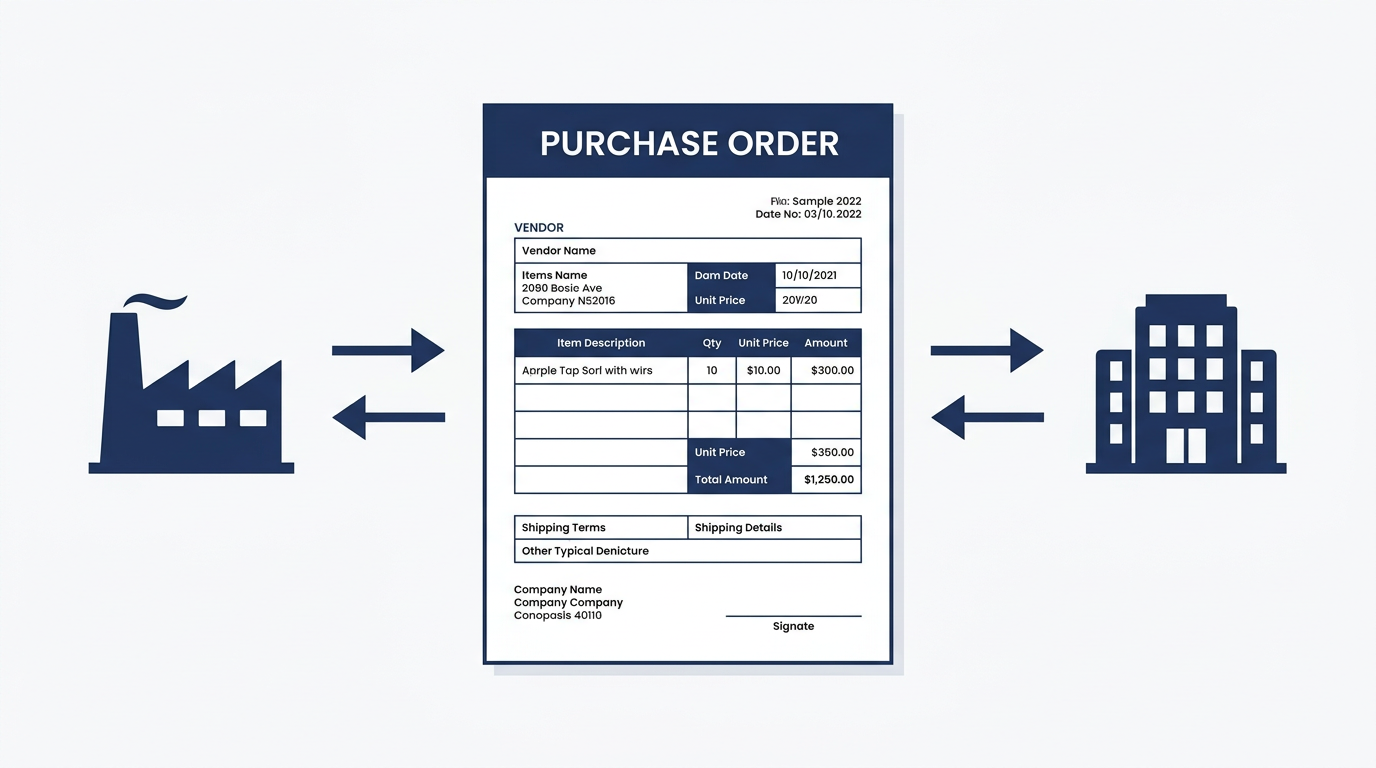
Most purchase order templates you find online were designed for ordering office supplies from a domestic vendor. They work fine when you're replenishing toner cartridges from Staples.
They fall apart when you're placing a 2,000-unit order with a manufacturer in Shenzhen.
The fields are wrong. The terms don't map to how factories in Asia process orders. And the critical sections - incoterms, production timelines, payment milestones, QC specs - are missing entirely.
At Workus AI, we've processed 200+ sourcing requests with manufacturers across China, Vietnam, India, and Southeast Asia. Here's the purchase order template that actually works for overseas supplier sourcing - and a field-by-field breakdown of why each section matters.
---
What Is a Purchase Order?
A purchase order (PO) is a legally binding document a buyer sends to a supplier to formally request goods at an agreed price. It's the document that transforms a verbal agreement or a quote acceptance into a contractual commitment.
For overseas supplier sourcing, a PO does four things a verbal or email agreement cannot:
- Creates a legal record - If the supplier ships the wrong product, the PO is your evidence of what was ordered.
- Locks in pricing - The unit price, incoterm, and payment terms in the PO override anything said in earlier negotiations.
- Sets production timelines - A clear production start date and ship date in the PO gives you grounds to hold the supplier accountable.
- Defines quality standards - Any QC specs, certifications, or inspection rights stated in the PO become part of the contract.
Sending a PO is not bureaucracy. It's how professional buyers protect themselves.
---
Free Purchase Order Template (Copy-Paste Ready)
PURCHASE ORDER

PO Number:     PO-[YYYY]-[NUMBER]   (e.g. PO-2026-0142)
Issue Date:    [DATE]
Valid Until:   [DATE + 30 days]

---

BUYER INFORMATION

Company Name:     [Your Company Name]
Contact Name:     [Name]
Email:            [Email]
Phone:            [Phone with country code]
Billing Address:  [Full address including country]

---

SUPPLIER INFORMATION

Factory / Company Name:  [Supplier Name]
Contact Name:            [Name]
Email:                   [Email]
Factory Address:         [Full address]
Business Registration:   [Supplier's local business reg. number]

---

SECTION 1: PRODUCT DETAILS

Line  Product Name       SKU/Style No.  Material & Specs    Color/Variant  Qty   Unit Price (USD)  Line Total
1     [Product Name]     [SKU-001]      [e.g. 350ml         [White/Matte]  500   $3.20             $1,600.00
                                         ceramic, lead-free]
2     [Product Name]     [SKU-002]      [...]               [...]          500   $3.20             $1,600.00

                                                                    SUBTOTAL:     $3,200.00
                                                                    FREIGHT:      [Quoted separately / TBD]
                                                                    TOTAL FOB:    $3,200.00

Note: All prices in USD. Incoterm: FOB [Port Name] (e.g. FOB Shenzhen).

---

SECTION 2: PRODUCTION AND SHIPPING TIMELINE

Deposit Due:              [DATE - typically within 5 business days of PO confirmation]
Production Start Date:    [DATE]
Production Completion:    [DATE]
Pre-Shipment Inspection:  [DATE] - Buyer / Third-party inspector (circle one)
Latest Ship Date:         [DATE]
Expected Arrival:         [DATE]
Destination Port:         [e.g. Port of Los Angeles / Rotterdam / Sydney]

---

SECTION 3: PAYMENT TERMS

Payment Method:     T/T (Telegraphic Transfer) / L/C (Letter of Credit) (circle one)
Deposit:            30% - USD $[AMOUNT] - Due within 5 business days of PO confirmation
Balance:            70% - USD $[AMOUNT] - Due [before shipment / against B/L copy]

Bank Details: [Provided separately by supplier - do not include banking info in the PO body]

---

SECTION 4: QUALITY SPECIFICATIONS

Approved Sample:         Sample reference [SAMPLE-REF-001] approved [DATE]
Acceptance Standard:     AQL 2.5 (or specify: zero defects on [critical item])
Inspection Rights:       Buyer reserves the right to inspect goods before shipment
Certifications Required: [e.g. FDA-safe materials / CE / REACH / none]
Packaging Spec:          [e.g. Individual white box + brown master carton, 12 units/carton]
Labeling:               [e.g. Country of origin label required on each unit]

---

SECTION 5: SHIPPING DOCUMENTATION REQUIRED

Upon shipment, supplier must provide:
  - Commercial Invoice (3 copies)
  - Packing List
  - Bill of Lading (or AWB if air freight)
  - Certificate of Origin (if required for customs)
  - [Any certification documents stated in Section 4]

All documents to be emailed within 24 hours of goods handover to freight forwarder.

---

SECTION 6: TERMS AND CONDITIONS

1. CANCELLATION: This PO may be cancelled if production has not started within [X] days of deposit receipt.
2. LATE DELIVERY: Supplier shall notify buyer immediately if ship date cannot be met.
3. DEFECTS: Goods that fail AQL inspection will be rejected. Supplier bears cost of
   replacement or refund.
4. CONFIDENTIALITY: Supplier agrees not to produce or sell this product design to
   third parties without written consent.
5. GOVERNING LAW: This agreement is governed by the laws of [Singapore / Hong Kong / your jurisdiction].

---

BUYER SIGNATURE

Authorized by:  ________________________    Date: ____________
Title:          ________________________

SUPPLIER ACKNOWLEDGMENT

This PO is accepted and confirmed by:  ________________________    Date: ____________
Title:                                 ________________________
---
Field-by-Field Breakdown: Why Each Section Matters for Overseas Orders
PO Number
Every PO needs a unique reference number you generate. Use a format like PO-2026-0142 - year plus sequential number. This reference goes on every follow-up email, shipping document, and invoice. Without it, tracking multiple concurrent orders from multiple factories becomes a documentation nightmare.
Supplier's Business Registration Number
This is the field most templates skip. For China suppliers, this is the Unified Social Credit Code (18 digits) on their business license. Including it in the PO confirms you're contracting with a legally registered entity - not a trading company posing as a factory - and gives you recourse if there's a dispute.
Incoterms in Section 1
The incoterm determines who bears risk and cost at each stage of the shipment. For overseas sourcing:
- FOB (Free on Board): Supplier delivers goods to the origin port. You arrange and pay for freight and insurance from that point. Most common for experienced buyers.
- EXW (Ex Works): Goods available at the factory gate. You handle everything from pickup. Lowest supplier price, highest buyer responsibility.
- CIF (Cost, Insurance, Freight): Supplier arranges shipping to your destination port. Convenient, but you have less control over freight costs and carrier selection.
Always state the specific port with the incoterm: FOB Shenzhen, not just FOB. A price quoted without an incoterm is not a comparable quote.
Section 2: Production Timeline
Most buyers include a delivery date but skip the production start date. That's backwards. What you actually need to enforce is: when does the factory commit to beginning production? A supplier who takes your deposit and delays production start by two weeks can't meet a ship date three weeks out - no matter what the ship date says.
Also include the pre-shipment inspection date. Inspection after goods are loaded is too late - the factory has already handed off control. Schedule inspection while the goods are in the factory, before they're palletized.
Section 3: Payment Terms - Never Pay 100% Upfront
Standard overseas sourcing payment structure:
- 30% deposit on PO confirmation (covers materials)
- 70% balance before shipment (or against shipping documents)
Variants to negotiate based on your leverage:
- First-time orders from an unverified supplier: consider a third-party escrow service
- High-volume repeat orders: push toward net-30 or net-60 terms
- Custom tooling/molds: sometimes a separate milestone payment before production start
Never wire the full amount upfront to a supplier you haven't worked with before.
Section 4: The AQL Standard
AQL (Acceptable Quality Limit) is the industry standard for defining how many defective units are acceptable in a production run. AQL 2.5 means in a sample of a given size, no more than 2.5% defects are acceptable before the shipment is rejected.
Buyers who skip this field leave the acceptance standard undefined - which means the supplier's own QC team decides what's acceptable. That never works in the buyer's favor.
For products where any defect is critical (safety, certification, branded packaging), use AQL 1.0 or specify zero tolerance on specific defect categories.
---
Purchase Order vs Invoice vs RFQ: What's the Difference?
| Document | Direction | When | Purpose |
|---|---|---|---|
| RFQ (Request for Quotation) | Buyer → Supplier | Before price agreement | Get comparable pricing quotes |
| Proforma Invoice | Supplier → Buyer | After RFQ, before PO | Supplier's formal price offer |
| Purchase Order | Buyer → Supplier | After price agreement | Legally commit to the purchase |
| Commercial Invoice | Supplier → Buyer | After shipment | Bill and customs declaration |
| Packing List | Supplier → Buyer | With shipment | What's in the boxes |
The sequence for a typical overseas order:
- You send an RFQ → supplier responds with pricing
- Supplier sends a Proforma Invoice confirming agreed terms
- You send a Purchase Order → supplier acknowledges and begins production
- At shipment, supplier sends a Commercial Invoice + Packing List + Bill of Lading
A PO without a prior RFQ is negotiating blind. A payment without a confirmed PO is a donation.
---
5 Purchase Order Mistakes That Cost Overseas Buyers Money
1. No AQL spec - accepting "our standard quality" Every factory has a quality standard. Without a written AQL in your PO, their standard applies. For a factory optimizing for throughput, that standard may be different from yours. Define acceptance criteria in the PO before production begins.
2. Vague or missing incoterm A $3.00/unit price quoted EXW from a factory in Guangdong becomes a $3.90/unit landed cost FOB Shenzhen once you account for domestic trucking to port. Always state the incoterm and the port. Compare supplier quotes on the same incoterm basis.
3. Ship date without production start date Suppliers sign up to ship dates and then overcommit. Include a production start date. If they miss the start date, you know three weeks before you'd otherwise find out - when there's still time to intervene.
4. Sending a PO before seeing an approved sample Reference the approved sample in Section 4 (sample reference number + date approved). If the production run deviates from the sample, the PO language gives you grounds to reject the shipment. Without the sample reference, you're disputing opinion.
5. No confidentiality clause for custom products If the product design is yours - a custom mold, a branded product, an exclusive colorway - add the confidentiality clause. Factories work with many buyers. Without a written clause, there's nothing stopping them from selling your design to a competitor who places a larger order.
---
How to Send a Purchase Order to a Supplier (Step-by-Step)
- Complete the RFQ and get a Proforma Invoice first. Never send a PO until you have the supplier's written price confirmation. The Proforma Invoice is the supplier's offer; your PO is the acceptance.
- Reference your approved sample. Before sending the PO, confirm the sample reference number. The PO's quality section should state: "Production must match sample [SAMPLE-REF-001] approved [date]."
- Send the PO as a PDF, not an editable Word/Excel file. Lock the document. You don't want the supplier to modify terms and send it back as if those were your terms.
- Request a written PO acknowledgment. The supplier's signature (or email reply confirming PO acceptance) is the contract. Follow up within 48 hours if you haven't received confirmation.
- Wire the deposit only after written acknowledgment. Never send payment in anticipation of confirmation. The acknowledgment is the trigger for the deposit - not the other way around.
- Track your PO with a simple spreadsheet. Log PO number, supplier, order value, deposit sent date, expected ship date, and balance due date. If you have three concurrent orders, this is non-negotiable.
Want to automate this entire process? Workus AI handles RFQ dispatch, supplier selection, PO management, and pre-shipment inspection coordination for physical goods sourcing. Start a sourcing request.
---
Leon Z is the Founder & CEO of Workus AI, an AI-powered procurement platform for physical goods sourcing. He has run 200+ sourcing projects across 7,000+ product categories in 200+ supplier countries. Before Workus, he built Selefra, a cloud infrastructure analytics platform.
Last updated: June 2026
FAQ
What should a purchase order template include for overseas suppliers?
A purchase order for overseas suppliers must include: PO number, buyer and supplier information (with the supplier's business registration number), product details with incoterm and port, production and shipping timeline (including production start date), payment terms (typically 30% deposit / 70% balance), quality specifications with AQL standard, required shipping documentation, and terms and conditions covering cancellation, late delivery, defects, and confidentiality.
What is the difference between a purchase order and an invoice?
A purchase order is sent by the buyer to the supplier to formally request goods at an agreed price — it's a commitment to buy. An invoice is sent by the supplier to the buyer after shipment as a bill and customs declaration. The sequence is: RFQ → Proforma Invoice (supplier's offer) → Purchase Order (buyer's acceptance) → Commercial Invoice (at shipment).
What incoterm should I use on a purchase order for China suppliers?
FOB (Free on Board) is the most common incoterm for experienced overseas buyers. The supplier delivers goods to the origin port; you arrange freight and insurance from that point. Always specify the port: 'FOB Shenzhen', not just 'FOB'. Compare supplier quotes on the same incoterm basis — a lower EXW price often becomes more expensive once you add domestic trucking to port.
What is AQL and should I include it in my purchase order?
AQL (Acceptable Quality Limit) is the industry standard for defining how many defective units are acceptable in a production run. AQL 2.5 means no more than 2.5% defects are acceptable in a sample before the shipment is rejected. Always include an AQL spec in your PO — without it, the supplier's own standard applies, which may differ significantly from yours.
Should I send my purchase order as a PDF or Word file?
Always send a purchase order as a locked PDF, not an editable Word or Excel file. An editable file can be modified by the supplier and sent back with altered terms. A signed or locked PDF creates a clear, unambiguous record of what was agreed.
Popular

Manufacturer Directory: The Best Ways to Find and Vet Manufacturers in 2026
Compare the top manufacturer directories in 2026 - ThomasNet, Alibaba, Global Sources, and AI-native platforms. Find the right one for your product and sourcing region.

Best Procurement Software for Small and Mid-Size Businesses in 2026
Compare the best procurement software for small and mid-size businesses in 2026. AI sourcing, RFQ automation, and spend management tools reviewed.

How to Find Manufacturers: The Complete Guide to Sourcing Physical Products
Learn how to find manufacturers for your physical product in 7 steps. Covers where to search, how to send RFQs, evaluate suppliers, and avoid common mistakes.