
Free RFQ Template 2026: Request for Quotation Template for Supplier Sourcing

By Leon Z, Founder & CEO, Workus AI | Last updated: July 2026
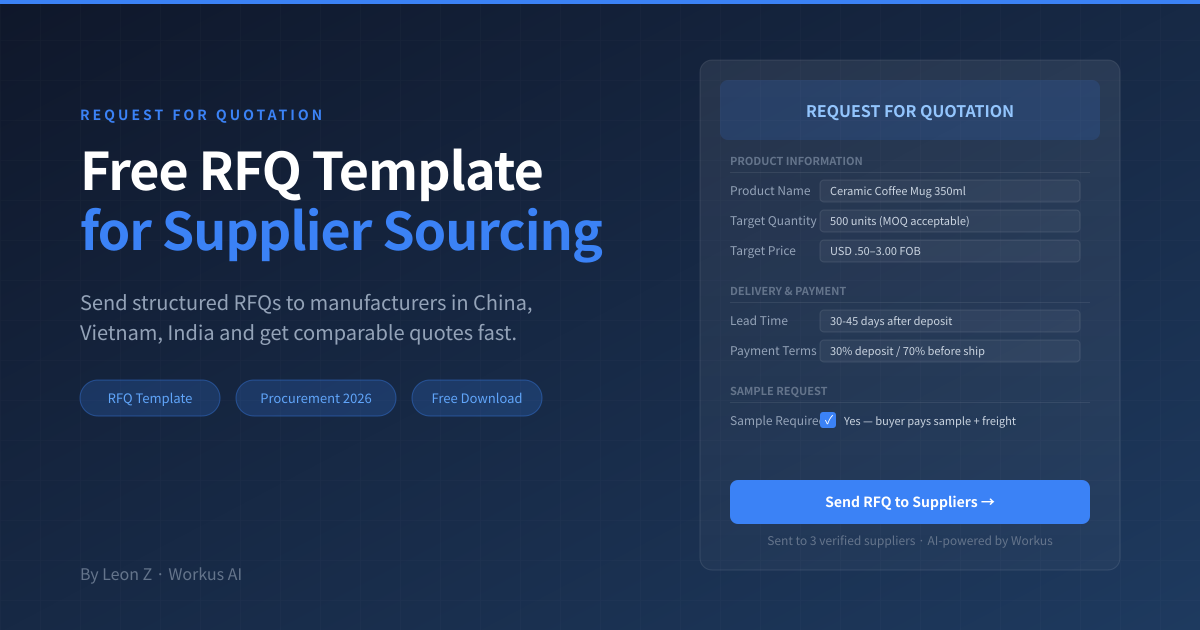
Most buyers contact overseas suppliers with a vague email: "Hi, do you make ceramic mugs? What's your price for 500 pcs?"
That email will get you a vague reply — or no reply at all.
Suppliers in China, Vietnam, and India receive hundreds of inquiries daily. The buyers who get fast, accurate quotes are the ones who send a structured RFQ (Request for Quotation) with the product specs, target quantity, incoterm, payment terms, and sample request all spelled out in one document.
At Workus AI, we've sent 200+ sourcing requests to manufacturers across Asia. Here's the RFQ template that gets suppliers to quote seriously — and a field-by-field breakdown of why each section matters.
---
What Is an RFQ (Request for Quotation)?
An RFQ (Request for Quotation) is a formal document a buyer sends to one or more suppliers asking for a price quote on specific goods. It defines exactly what you want to buy so that every supplier quotes on the same basis — making their responses directly comparable.
An RFQ is not a purchase order. It's not a commitment to buy. It's a structured question: "On these exact terms, what is your best price?"
For overseas manufacturer sourcing, a well-written RFQ does four things a casual inquiry email cannot:
- Forces apples-to-apples comparison — Every supplier quotes the same incoterm, the same quantity, the same spec. You can compare line by line.
- Pre-qualifies suppliers — Suppliers who can't meet your requirements or target price will say so in their response, saving you weeks of back-and-forth.
- Signals you're a professional buyer — A structured RFQ tells the supplier this isn't a tire-kicker inquiry. You tend to get better pricing and faster responses.
- Creates a paper trail — The RFQ and the supplier's response (their proforma invoice) become the foundation of your purchase agreement.
The procurement sequence for any overseas order should be:
RFQ → Proforma Invoice → Purchase Order → Commercial Invoice
Never skip the RFQ step. Sending a PO without prior quotes means you're negotiating blind.
---
Free RFQ Template (Copy-Paste Ready)
The template below is structured for overseas manufacturer sourcing. Fill in the brackets, remove the instructions in parentheses, and send as a PDF.
REQUEST FOR QUOTATION (RFQ)

RFQ Number:    RFQ-[YYYY]-[NUMBER]     (e.g. RFQ-2026-0047)
Issue Date:    [DATE]
Response Due:  [DATE + 7–10 business days]

---

BUYER INFORMATION

Company Name:     [Your Company Name]
Contact Name:     [Your Name]
Email:            [Your Email]
Phone:            [Phone with country code]
Website:          [Your website, if applicable]

---

SUPPLIER INFORMATION

To:    [Supplier Company Name / "To Whom It May Concern" if broadcasting to multiple]
Attn:  [Contact Name, if known]

---

SECTION 1: PRODUCT DETAILS

Product Name:        [e.g. Ceramic Coffee Mug]
Product Description: [Brief description of what the product is and what it does]

Specifications:

  Material:          [e.g. High-fired ceramic, lead-free glaze]
  Dimensions:        [e.g. 350ml capacity, 9cm H × 8cm diameter]
  Weight (unit):     [e.g. 280g per unit]
  Colors/Variants:   [e.g. Matte white, matte black — 2 colors]
  Finish:            [e.g. Matte exterior, glossy interior]
  Special Features:  [e.g. Microwave safe, dishwasher safe]
  Compliance:        [e.g. FDA-safe materials required / REACH compliant / none]

Reference:           [Link to product image, sketch, or spec sheet — or attach]

---

SECTION 2: QUANTITY AND PRICING

Target Order Quantity:    [e.g. 500 units (initial order)]
Future Volume Estimate:   [e.g. 2,000–5,000 units per quarter if quality confirmed]
Acceptable MOQ:           [e.g. Willing to discuss MOQ — please state your minimum]

Target Unit Price:        USD $[X]–$[Y] per unit
Incoterm:                 FOB [Port Name]  (e.g. FOB Shenzhen / FOB Ho Chi Minh City)

Note: Please quote in USD. If your pricing is above our target range, please still
respond — indicate your best price and we will consider.

---

SECTION 3: LEAD TIME AND DELIVERY

Required Ship Date:       [DATE] or sooner
Production Lead Time:     Please confirm production lead time from deposit receipt
Sample Lead Time:         Please confirm sample production and delivery timeline
Destination Port:         [e.g. Port of Los Angeles / Rotterdam / Sydney]

---

SECTION 4: PAYMENT TERMS

Expected Payment Method:  T/T (Telegraphic Transfer)
Expected Structure:       30% deposit on PO confirmation / 70% balance before shipment

Note: If you require different terms for new buyers, please state your standard
terms and we will consider.

---

SECTION 5: SAMPLE REQUEST

Sample Required:          Yes / No (circle one)

If yes:
  Sample Type:     Pre-production sample (before mass production commitment)
  Sample Cost:     Please quote sample cost (buyer will pay)
  Sample Shipping: Please quote DHL/FedEx express cost to [destination country]
  Sample Timeline: How many days to produce and ship sample?

---

SECTION 6: PACKAGING AND LABELING

Unit Packaging:   [e.g. Individual white gift box / polybag / no retail packaging]
Master Carton:    [e.g. Brown export carton, max 15kg per carton]
Labeling:         [e.g. "Made in China" label required on each unit / barcode required]
Custom Branding:  [e.g. Logo printed on product — art file to be provided / none]

---

SECTION 7: CERTIFICATIONS AND COMPLIANCE

Required Certifications:  [List any required: FDA, CE, REACH, RoHS, LFGB, etc. / None]
Test Reports:             [e.g. Third-party test report required before shipment / None]
Factory Audit:            [e.g. Buyer may require factory audit / Not required]

---

SECTION 8: SUPPLIER INFORMATION REQUESTED

Please include in your response:
  1. Company name, address, and business registration number
  2. Factory location (city, province, country)
  3. Years in operation
  4. Main product categories
  5. Annual production capacity for this product
  6. Current certifications held (ISO, BSCI, audit reports, etc.)
  7. Minimum 3 reference buyers (company names / countries — not contacts)

---

QUOTE RESPONSE DEADLINE

Please respond by: [DATE]

Responses received after this date may not be considered.
If you need clarification before quoting, email [your email] by [DATE - 2 days].

---

TERMS OF THIS RFQ

This RFQ is a request for pricing only — not a commitment to purchase.
The buyer reserves the right to accept, reject, or negotiate any quote received.
All information in this RFQ and supplier responses are to be treated as confidential.

---

Submitted by:

Name:     [Your Name]
Title:    [Your Title]
Company:  [Company Name]
Date:     [DATE]
---
Field-by-Field Breakdown: Why Each Section Matters
RFQ Number
Every RFQ needs a unique reference number you generate. Use RFQ-2026-0047 format — year plus sequential number. This goes on every follow-up email and makes supplier responses easy to track. When you're running three concurrent sourcing projects, an RFQ number is the only way to keep communications organized.
Section 1: Product Specifications
This is the section most buyers under-fill. "Ceramic mug, 350ml, matte white" is not enough. Suppliers in Asia need to know:
- Material and grade: "Lead-free ceramic" vs. "ceramic" means different procurement costs for the factory. Specify it.
- Compliance requirements: If you're selling in the EU or US, "FDA-safe materials" or "REACH compliant" must appear here. A supplier who quotes on non-compliant materials is quoting a product you can't sell.
- Reference file: Attach a product image, tech pack, or a link to a comparable product. Suppliers quote faster and more accurately when they can see what you're describing.
Section 2: Quantity, Price, and Incoterm
Never omit the incoterm. A quote of "$2.80 per unit" means nothing without knowing the incoterm. A $2.80 EXW price from Guangdong becomes $3.40 landed FOB Shenzhen once you add domestic trucking to port. Without a stated incoterm, you cannot compare quotes from different suppliers.
Include a target price range. Buyers who include a target price get better responses. It:
- Pre-qualifies suppliers (those who can't hit $3.00 will say so upfront)
- Anchors the negotiation before it begins
- Signals market knowledge — suppliers respect buyers who have done homework
Section 3: Lead Time
Ask for two lead times: production lead time (from deposit to goods ready for inspection) and sample lead time (from order to sample delivery). Both matter.
A supplier who quotes a 30-day production lead time but a 15-day sample lead time may have a bottleneck in sample production that's a warning sign for mass production delays. Inconsistencies here are worth asking about.
Section 4: Payment Terms
State your expected payment structure upfront. The most common structure for Asia sourcing is:
- 30% deposit on PO confirmation (covers raw materials)
- 70% balance before shipment (or against shipping documents)
If you leave payment terms out of the RFQ, you're starting a negotiation from a blank slate. Including your expected terms gives you leverage: suppliers who want your business accept your terms or propose an alternative you can counter.
Section 5: Sample Request
Always request a pre-production sample before committing to a mass production order. A pre-production sample (also called a "PP sample") is produced using the same materials, process, and equipment as the production run — not a one-off handmade prototype.
Include sample cost and shipping cost fields. Suppliers who refuse to quote sample costs upfront are a yellow flag — it usually means they're hoping to absorb it into the mass production margin, which creates misaligned incentives.
Section 6: Packaging and Labeling
Packaging spec is frequently skipped and then becomes a dispute at inspection. If you need a specific carton size (to optimize container loading), specific labeling (for customs or retail compliance), or branded packaging, state it in the RFQ. A supplier who doesn't account for custom packaging in their quote will come back with an upcharge after the PO is signed.
Section 7: Certifications
If your market requires specific certifications (CE for EU electronics, FDA for US food contact, REACH for EU chemicals, LFGB for German food contact), this field is mandatory. A supplier who doesn't flag certification capability at the RFQ stage may not be able to deliver compliant goods — and you won't find out until you're holding 500 units you can't import.
Section 8: Supplier Information
Asking for a business registration number upfront is the single most effective filter in your RFQ. Trading companies masquerading as factories rarely have a consistent answer to "what is your factory's business registration number?" Legitimate manufacturers answer immediately. This one field will eliminate a significant percentage of non-factory responses.
---
RFQ vs Purchase Order vs Proforma Invoice: The Document Flow
| Document | Direction | When | Purpose |
|---|---|---|---|
| RFQ | Buyer → Supplier | Before any agreement | Request comparable pricing quotes |
| Proforma Invoice | Supplier → Buyer | After RFQ, before PO | Supplier's formal price and terms offer |
| Purchase Order | Buyer → Supplier | After price agreement | Legally commit to the purchase |
| Commercial Invoice | Supplier → Buyer | After shipment | Bill and customs declaration |
| Packing List | Supplier → Buyer | With shipment | Itemized contents of the shipment |
The correct sequence for overseas sourcing:
- You send an RFQ to 3–5 verified suppliers
- Suppliers respond with Proforma Invoices (their pricing offers)
- You select a supplier and negotiate final terms
- You send a [Purchase Order](/blog/purchase-order-template) → supplier acknowledges and begins production
- At shipment, supplier sends Commercial Invoice + Packing List + Bill of Lading
Skipping the RFQ step means skipping competitive pricing. Skipping the Proforma Invoice means sending a PO without documented agreement on terms. Both shortcuts create disputes downstream.
---
How to Send an RFQ to Overseas Suppliers (Step-by-Step)
Step 1: Build your supplier shortlist first. Send your RFQ to 3–8 verified suppliers — not cold contacts from a directory. Use platforms that verify factory status, production capabilities, and business registration. An RFQ sent to an unverified supplier list is noise. Target suppliers who have produced your product category before.
Step 2: Send the RFQ as a PDF. Do not send your RFQ as a Word or Excel file. An editable file can be returned with altered specs. A locked PDF creates a clear, shared record of what was requested.
Step 3: Set a response deadline. Give suppliers 7–10 business days to respond. Include a clarification cutoff 2 days before the deadline — if a supplier has questions, you want those answered before the quote deadline, not during. Suppliers who miss the deadline without notice are showing you their communication habits.
Step 4: Compare responses on the same basis. Receiving five quotes at different incoterms, different quantities, and different payment terms is not a useful comparison. Your RFQ standardizes the inputs so supplier responses can be compared line by line. If a supplier ignores your stated incoterm, ask them to requote — or deprioritize their response.
Step 5: Follow up systematically. After the response deadline, email non-responding suppliers once. Then move on. A supplier who doesn't respond to a structured RFQ within 10 business days is not a reliable partner for production timelines.
Step 6: Request the Proforma Invoice from your top 2–3 candidates. After reviewing quotes, shortlist your top candidates and ask each for a formal Proforma Invoice — their offer on the exact terms you want. The PI is the document you'll reference when negotiating and drafting the PO. You'll also want to confirm the supplier's minimum order quantity aligns with your initial order size before committing.
Want to skip the spreadsheet juggling? Workus AI dispatches your RFQ to matched, verified manufacturers, aggregates responses in a side-by-side comparison table, and flags inconsistencies — all in one platform. Start your RFQ on Workus AI.
---
5 RFQ Mistakes That Get You Bad Quotes (or No Quotes)
1. Sending a vague product description "I need a ceramic mug" generates a range of quotes. "350ml lead-free ceramic mug, matte exterior, glossy interior, FDA-safe glaze, 500 units, FOB Shenzhen" generates comparable quotes. The more specific the RFQ, the more useful the responses.
2. No incoterm A price without an incoterm is unquotable. Some buyers receive quotes and don't realize until they try to ship that they're comparing an EXW price to a CIF price — a difference of 20–40% once freight and insurance are factored in. Always state the incoterm and specific port.
3. Not asking for sample costs upfront Suppliers who quote the product but not the sample are counting on you to forget about it. Get the sample cost and express shipping cost in the RFQ response. If a supplier refuses to state sample cost, they're planning to recover it elsewhere.
4. Sending to too many unverified suppliers Sending an RFQ to 20 contacts from a directory feels productive. It isn't. You'll get 5–8 responses from trading companies, a few factory responses, and none of them will match your specs precisely. Quality supplier shortlisting beats quantity every time.
5. No response deadline Without a deadline, supplier responses arrive over weeks — and you can't do a real comparison if responses are 2 weeks apart. A stated deadline of 7–10 business days with a clarification cutoff creates urgency and allows you to compare everything at once.
---
RFQ Template for Different Product Types
The core template above works for most physical goods. Here are the field adjustments for specific categories:
Electronics and Tech Products
Add to Section 7 (Certifications):
- FCC certification (US market)
- CE + RoHS certification (EU market)
- UN 38.3 battery testing (if lithium battery included)
Add to Section 1 (Specs):
- PCB specs, battery capacity, wireless standards (if applicable)
- IP rating (water/dust resistance)
Apparel and Textiles
Add to Section 1 (Specs):
- Fabric composition (e.g. 100% organic cotton, 200 GSM)
- Size range and size spec sheet
- Care label requirements (washing instructions per destination market)
Add to Section 7 (Certifications):
- OEKO-TEX Standard 100 (if required)
- GOTS (Global Organic Textile Standard, if applicable)
Food Contact / Kitchen Products
Add to Section 7 (Certifications):
- FDA-safe materials declaration (US market)
- LFGB certification (German/EU food contact)
- REACH compliance (EU)
Add to Section 1 (Specs):
- Material safety: specify "lead-free", "BPA-free", "food-safe" as required
Cosmetics and Personal Care
Add to Section 7 (Certifications):
- GMP (Good Manufacturing Practice) certification
- Country-specific cosmetics registration (FDA for US, EU Cosmetics Regulation notification)
Add to Section 1 (Specs):
- Formula information (if custom formulation)
- Shelf life requirement
- Preservative system (if regulated)
---
How Workus AI Automates the RFQ Process
Sending RFQs manually means:
- Building a supplier shortlist from scratch
- Formatting and sending the RFQ via email to each supplier individually
- Tracking responses in a spreadsheet
- Manually comparing quotes with different formats and incoterms
- Chasing non-responders
Workus AI handles the entire flow:
- You describe what you want to source — product specs, quantity, target price, and timeline
- Workus matches you to verified manufacturers with experience in your product category
- Workus dispatches your structured RFQ to the matched supplier shortlist
- Supplier responses are aggregated into a standardized comparison table — same incoterm, same fields, no spreadsheet required
- You select your preferred supplier and Workus generates the purchase order
For procurement teams sourcing physical goods from Asia, this eliminates the manual overhead that makes RFQ campaigns slow and error-prone.
Start a sourcing request on Workus AI — describe your product and get matched to verified manufacturers.
---
Leon Z is the Founder & CEO of Workus AI, an AI-powered procurement platform for physical goods sourcing. He has run 200+ sourcing projects across 7,000+ product categories in 200+ supplier countries. Before Workus, he built Selefra, a cloud infrastructure analytics platform.
Last updated: July 2026
FAQ
What is an RFQ (Request for Quotation)?
An RFQ (Request for Quotation) is a document a buyer sends to suppliers asking for a formal price quote on specific goods. It details what you want to buy, how many units, your quality requirements, delivery timeline, and payment expectations. Suppliers respond with their pricing and terms. Unlike a general inquiry email, a structured RFQ forces suppliers to quote on the same basis — making it easier to compare responses and negotiate.
What should an RFQ template include for overseas suppliers?
An RFQ for overseas manufacturers should include: (1) product name and detailed specifications (material, dimensions, color, finish), (2) target quantity and acceptable MOQ, (3) target unit price and incoterm (FOB, CIF, EXW), (4) required lead time and delivery timeline, (5) payment terms expectation (e.g. 30/70 T/T), (6) sample request instructions, (7) required certifications (CE, FDA, REACH), (8) packaging and labeling requirements, and (9) quote validity period and response deadline.
What is the difference between an RFQ and a purchase order?
An RFQ (Request for Quotation) is sent before any agreement — it asks suppliers to propose their price and terms. A Purchase Order (PO) is sent after you've selected a supplier and agreed on terms — it's a legally binding commitment to buy. The document sequence for overseas sourcing is: RFQ → Proforma Invoice (supplier's offer) → Purchase Order (buyer's acceptance) → Commercial Invoice (at shipment). Never skip the RFQ step: sending a PO without prior quotes means you never know if you're getting a fair price.
How many suppliers should I send an RFQ to?
Send your RFQ to at least 3–5 verified suppliers, and no more than 8–10. Fewer than 3 doesn't give you enough price competition. More than 10 dilutes your attention during follow-up and signals to good suppliers that you're not a serious buyer. Target suppliers who have experience with your product category, have verifiable business registrations, and are willing to provide samples. Quality of suppliers matters more than quantity.
Should I include my target price in the RFQ?
Yes — including a target price range in your RFQ is recommended for overseas sourcing. It pre-qualifies suppliers (those who can't meet your range will say so upfront, saving everyone time), and it signals that you're a serious buyer who has done market research. Frame it as: 'Our target landed cost is USD $X–Y per unit FOB [port]. Please indicate if your pricing is within this range.' Don't reveal your absolute ceiling, but anchoring the negotiation with a realistic range accelerates the RFQ process.
Popular

Manufacturer Directory: The Best Ways to Find and Vet Manufacturers in 2026
Compare the top manufacturer directories in 2026 - ThomasNet, Alibaba, Global Sources, and AI-native platforms. Find the right one for your product and sourcing region.

Best Procurement Software for Small and Mid-Size Businesses in 2026
Compare the best procurement software for small and mid-size businesses in 2026. AI sourcing, RFQ automation, and spend management tools reviewed.

How to Find Manufacturers: The Complete Guide to Sourcing Physical Products
Learn how to find manufacturers for your physical product in 7 steps. Covers where to search, how to send RFQs, evaluate suppliers, and avoid common mistakes.